


Information on this page is intended for Ireland healthcare professionals only and may contain promotional material
This page is only intended for Irish healthcare professionals.
Adverse event reporting can be found near the bottom of the webpage. Click the bottom right button for Prescribing Information.
ASACOLON 1600mg Tablets
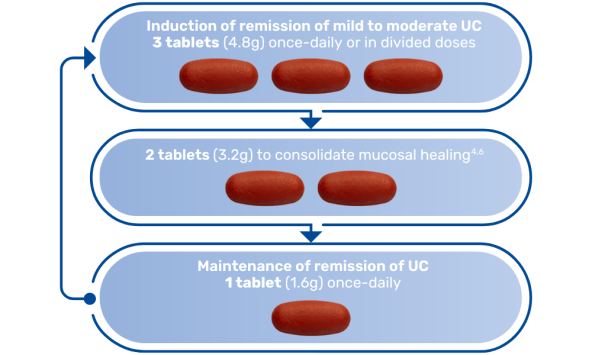
Help get your Ulcerative Colitis patients into remission on 4.8g with three tablets, once daily*1
Induction at 4.8g/day
- The maximum mesalazine induction dose in 3 tablets1,2
Maintenance at 1.6g/day
- 70% of patients maintained remission over 6 months3
Once remission from acute exacerbation is reached, gradually reduce the dose to the maintenance dose. Continued therapy should be carefully considered in subjects not responding by week 8**1.
*Tablets not at actual size
**If an alternative dose for maintenance treatment is considered more appropriate, other oral mesalazine formulations are available.
ASACOLON 1600mg is designed to aid adherence and can be taken with or without food1,3,5-8
* ASACOLON® 1600mg tablets can be administered in divided doses if required or if this aids adherence.
Opticore is designed to accurately deliver Asacolon 1600mg throughout the colon, including distally5,8
OPTICORE coating
Opticore coating is designed to reliably release 4.8g of Octasa 1600mg throughout the entire colon (even distally) in three tablets for the induction of remission1,5,8
Find out how Asacolon 1600mg works

ASACOLON 1600mg tablets three tablets once-daily*
*Example of prescription for the induction of remission of UC.
Report a side effect
Adverse events should be reported. Reporting forms and information can be found at:
https://www.hpra.ie/report-an-issue/medicines-for-human-use/side-effects
Adverse events should also be reported to Tillotts Pharma UK Ltd on:
Tel: +353 1 2942015
Email: Pvireland@tillotts.com
- 1.Asacolon® 1600mg Modified Release Tablets – Summary of Product Characteristics.
- 2.MIMS. Accessed online, April 2024.
- 3.D’Haens GR et al. Aliment Pharmacol Ther 2017; 46(3): 292–302.
- 4.Lichtenstein GR et al. Aliment Pharmacol Ther 2011; 33(6): 672–678.
- 5.Varum F et al. Int J Pharm 2022; 625: 122055
- 6.MacKenzie-Smith L et al. Inflamm Intest Dis 2018; 3(1): 43–51.
- 7.Murray A et al. Cochrane Database Syst Rev 2020; 8(8): CD000544
- 8.Varum F et al. Int J Pharm 2020; 583: 119372.
PM-DIF200-IE-00020 | October 2025
