

Information on this page is intended for Ireland healthcare professionals only and may contain promotional material
Dificlir (fidaxomicin)
Dificlir (fidaxomicin) film-coated tablets and Dificlir granules for oral suspension are antibiotics which contains the active substance fidaxomicin.
Dificlir is used to treat infections of the large intestine caused by the bacteria called Clostridioides difficile (C. difficile). These infections can cause severe diarrhoea. Dificlir acts on the bacteria that cause the infection.
To learn more about Clostridioides difficile visit the GI health section of our website here
Dificlir 40 mg/ml granules for oral suspension
Dificlir 200 mg film-coated tablets
What is Dificlir and what is it used for?
Dificlir is an antibiotic used to treat infections of the large intestine caused by the bacteria called Clostridioides difficile (C. difficile). These infections can cause severe diarrhoea. Dificlir acts on the bacteria that cause the infection.


How should Dificlir granules be taken?
The granules are taken as an oral suspension, prepared and measured as instructed by a healthcare professional or pharmacist.
Your pharmacist or healthcare professional will prepare Dificlir oral suspension before giving it to you. If the product is not provided to you as a suspension, please contact your pharmacist or healthcare professional. Use the oral syringe and adaptor provided by the pharmacist or healthcare professional to make sure you measure the right amount. If an oral syringe and adaptor has not been provided to you, please contact your pharmacist or healthcare professional. Your pharmacist will advise you how to measure the medicine using the oral syringe.
The suspension can be taken with or without food, and the full course should always be completed even if symptoms improve earlier.
For further information on how to take Dificlir please refer to the patient information leaflet included with your medication
How do I take Dificlir tablets?
Swallow the tablets whole with water. Take them exactly as prescribed. Do not crush, chew, or break the tablets. You can take Dificlir before, during or after meals.
Standard dosing for patients weighing at least 12.5kg is one tablet twice daily for a 10 day period.
Some patients may be prescribed an alternative dosing schedule, known as extended-pulsed dosing. For support in following an extended‑pulse dosing regimen please refer to the Dificlir extended-pulsed dosing section below.
For further information on how to take Dificlir please refer to the patient information leaflet included with your medication

Dificlir extended-pulsed dosing
This schedule is intended to support patients in following an extended‑pulse dosing regimen, as prescribed by a healthcare professional. This tool is not appropriate for use in patients who have been prescribed other dosage regimens of Dificlir.
View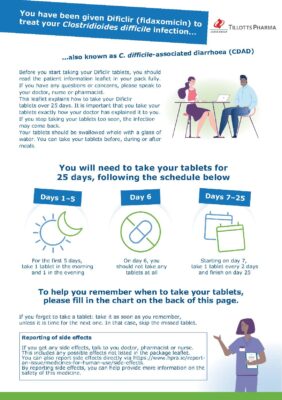
Other resources
The C.Diff Trust offers a wide range of information and support for people affected by Clostridioides difficile infection. Please click here to visit their website for further information.

If you have any questions or concerns about your medication, please speak to your healthcare professional
Frequently Asked Questions
Can I stop taking Dificlir when my diarrhoea improves?
No. You should complete the full course of treatment even if you start to feel better. Stopping early may increase the risk of the infection coming back.
What should I do if I forget to take a dose?
If you forget a dose, take it as soon as you remember, unless it is almost time for your next dose. In that case, skip the missed dose. Do not take a double dose to make up for a missed one.
What should I do if I take more Dificlir than I should?
Tell your doctor or pharmacist if you are taking, have recently taken, or might take any other medicines, including non‑prescription medicines.
Can I take Dificlir if I am allergic to antibiotics?
Do not take Dificlir if you are allergic to Dificlir or any of its ingredients. If you are allergic to macrolide antibiotics, speak to your doctor before taking Dificlir.
Can I take Dificlir during pregnancy or while breastfeeding?
If you are pregnant, think you may be pregnant, or are breastfeeding, ask your doctor or pharmacist for advice before taking Dificlir.
Will Dificlir affect my ability to drive or use machines?
Dificlir is not expected to affect your ability to drive, use tools or machines.
What should I do if I get side effects?
If you get any side effects, talk to you doctor, pharmacist or nurse. This includes any possible effects not listed in the package leaflet.
You can also report side effects directly via https://www.hpra.ie/report-an-issue/medicines-for-human-use/side-effects.
Seek urgent medical help and stop taking Dificlir if you have severe allergic reactions such as swelling of the face or throat, difficulty breathing, severe itching, severe hives or a severe rash.
Please refer to the patient information leaflet included with your medication for a list of common side effects.
Who are Dificlir tablets suitable for?
Dificlir tablets are used in adults, adolescents, and children with a body weight of at least 12.5 kg when prescribed by a healthcare professional to treat Clostridioides difficile infection.
If you have kidney or liver problems, ask your doctor for advice before using this medicine. Your doctor will tell you whether this medicine is suitable for you.
Can I crush or chew Dificlir tablets?
No. The tablets should be swallowed whole and must not be crushed or chewed.
Do I need to take the tablets with food?
No. Dificlir tablets can be taken with or without food.
How should Dificlir tablets be stored?
Keep out of the sight and reach of children. Do not use after the expiry date. Ask your pharmacist how to dispose of unused medicines safely.
Who are Dificlir granules suitable for?
Dificlir granules for oral suspension can be used in adults, adolescents, and children from birth to less than 18 years, particularly when tablets are not suitable to treat Clostridioides difficile infection’.
If you have kidney or liver problems, ask your doctor for advice before using this medicine. Your doctor will tell you whether this medicine is suitable for you.
Do I need to take special care when measuring the oral suspension?
Yes. Always use the oral dosing syringe or measuring device provided or recommended by your pharmacist to ensure the correct dose is taken. Household teaspoons should not be used.
How should Dificlir granules and the prepared oral suspension be stored?
After preparation by your healthcare professional or pharmacist, the oral suspension should be stored in a refrigerator and used within the time specified by the healthcare professional or pharmacist. Do not use the suspension after this time and return any unused medicine to your pharmacist.
Keep this medicine out of the sight and reach of children
What should I do with unused oral suspension?
Any unused oral suspension should be returned to a pharmacist. Do not throw it away with household waste or wastewater.
Report a side effect
Reporting of side effects: If you get any side effects, talk to you doctor, pharmacist or nurse. This includes any possible effects not listed in the package leaflet.
You can also report side effects directly via https://www.hpra.ie/report-an-issue/medicines-for-human-use/side-effects.
You can also report side effects to the marketing authorisation holder. Tillotts Pharma Ltd. On +353 1 2942015 or Pvireland@tillotts.com.
By reporting side effects, you can help provide more information on the safety of this medicine.
NP-DIF200-IE-00005 | July 2026
