

Information on this page is intended for Ireland healthcare professionals only and may contain promotional material
Ulcerative colitis

What is Ulcerative Colitis and what are the symptoms?
Ulcertative colitis (UC) is a type of inflammatory bowel disease, UC is a chronic (life-long) inflammatory disorder which causes inflammation and ulcers in the large intestine (colon), the disease usually starts in the rectum, and extends backwards along the colon.1
There are different types of ulcerative colitis depending on the areas of inflammation and ulceration:
- Proctitis – Disease affecting the rectum only.
- ‘Left-sided’ or ‘distal’ colitis – If the disease affects larger areas of the colon.
- ‘Extensive’ colitis or ‘pancolitis’ – The whole colon is affected.
Proctitis

Left-sided Colitis

Pancolitis

The characteristic symptom of UC is bloody diarrhoea, however patients may also experience stomach pain, tiredness, an urge to empty the bowel even when empty, and in severe cases fever. Patients with UC may go for long periods without experiencing symptoms, this period is known as remission, whereas periods of disease activity and active symptoms are known as a flare.1
Diagnosing UC
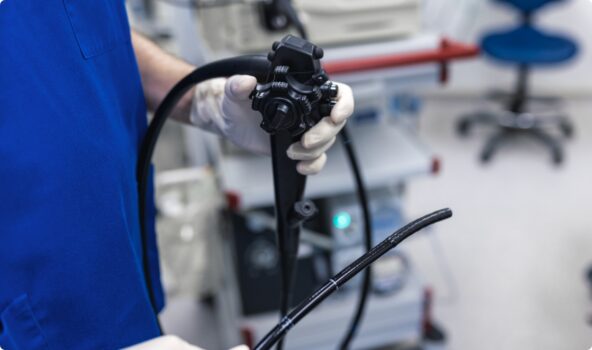
UC is commonly diagnosed based on clinical symptoms, along with an examination of the colon (endoscopy), and a microscopic examination of cells taken from the colon (histology). Before confirming a diagnosis of UC, other potential causes of diarrhoea such as infection, cancer, and side effects from drugs will usually be ruled out.1
The extent to which the colon is affected will be assessed as part of the endoscopy procedure, with disease severity assessed based on number of daily stools, and the presence or absence of fever and rapid heart rate. Most patients have mild to moderate disease at diagnosis, with less than 10% having severe disease.1
Diagnosis of UC peaks in two distinct age groups, between 15 and 30 years of age and between 50 and 70 years of age.1

References
1.Ordás I, et al. Lancet 2012;380:1606-1619.
NP-TP-IE-00023 | April 2026
